
Why have study circles remained so popular for over three decades?
Because they reconnect what modern life often pulls apart: open dialogue, shared experience, community, knowledge, and action.
They restore a collective sense of agency—the belief that, together, people have the power to understand, change, and improve the world around them. Study circles are spaces where adults link learning to life’s big questions and local realities. They emerge wherever people feel a need, a desire, or a responsibility to improve, explore, revive, or preserve something.
People join study circles out of genuine interest: a desire to understand their environment, to co-create, or to contribute to the common good. While the learning is informal, it is of high quality. It is rooted in conversation, experience, mutual respect, and a style of guidance that leaves ample room for participant initiative.
Groups typically consist of 5 to 12 participants. This size ensures a safe environment, active participation from everyone, and a rich diversity of experience. The atmosphere is non-competitive, defined by participation, collective thinking, and open discourse.
Study circles differ from traditional lectures or standard courses; here, the participant is a co-creator, not just a listener. The group develops its own ideas, its own dynamics, and its own unique path toward its goals.
The management of a study circle follows a well-established andragogical (adult learning) cycle. This framework provides stability and transparency while allowing for flexibility:
- Identifying needs;
- Defining goals;
- Planning;
- Implementation;
- Ongoing evaluation;
- Presenting results to the community. Crucially, every phase is "bottom-up," shaped through dialogue between the participants and the mentor.
The mentor is not a traditional teacher, but a professionally trained facilitator. They guide the process by encouraging reflection, structuring steps, listening, and creating a space for group cohesion and effectiveness.
The mentor manages both the organisational and the social-emotional aspects of the group. Their work is often subtle but vital: they help establish a culture of dialogue, encourage cooperation, and empower participants to find their own solutions.
Study circles operate on the principle that adults learn most effectively and holistically when they connect new knowledge to their own lived experience. Consequently, learning is experiential and practical, deeply entwined with the local area and its people.
Every study circle culminates in an "action"—a visible contribution where the group transforms new knowledge into something that benefits the environment, the community, or the understanding of a chosen topic. This might include:
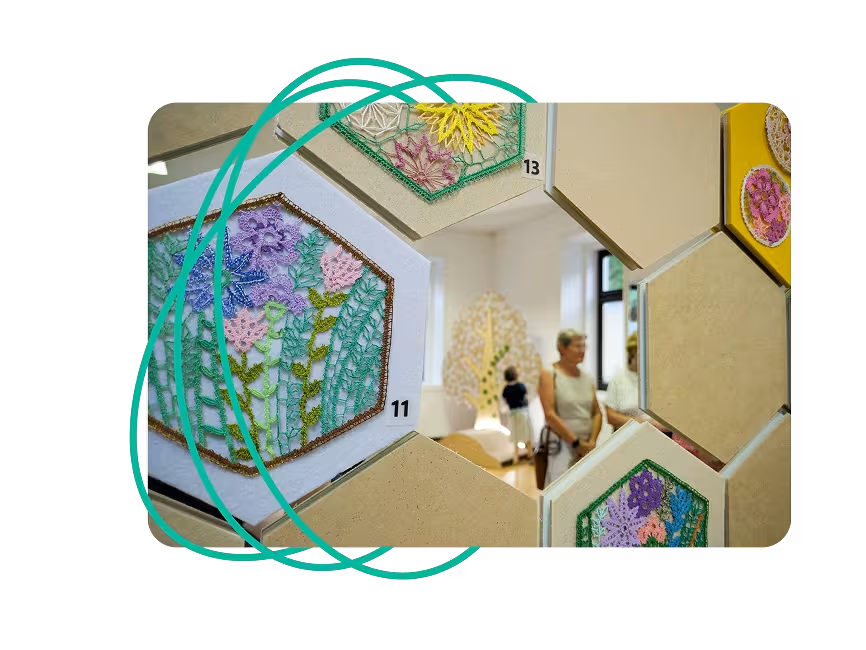
- An exhibition;
- Restoring a trail or a community space;
- Collecting and interpreting local heritage;
- A publication or digital record;
- A community event;
- Developing a new skill or area of expertise. The action is not just an end result; it is a feedback loop where the community enjoys the fruits of the learning, and the participants receive meaningful validation.
Data and evaluations show that study circles are intergenerational at their core. Groups bring together everyone from young adults to seniors.
This cooperation is rarely a forced goal; rather, it is a natural result of engaging topics, a free learning space, and the authentic human need for connection. The generations complement one another: some bring digital agility and speed, others bring depth of experience, and others a sense of local history, tradition, and relationships.
While study circles avoid rigid hierarchy, they are not unorganised. The balance between freedom and agreed-upon steps is exactly what allows a group to produce high-quality results that transcend the individual. A strong underlying structure supports the process:
- Clear milestone goals;
- Agreed communication rules;
- Active monitoring of the process;
- Collaborative conflict resolution.